Wednesday, December 7, 2011

Socialism...Is it Cool?


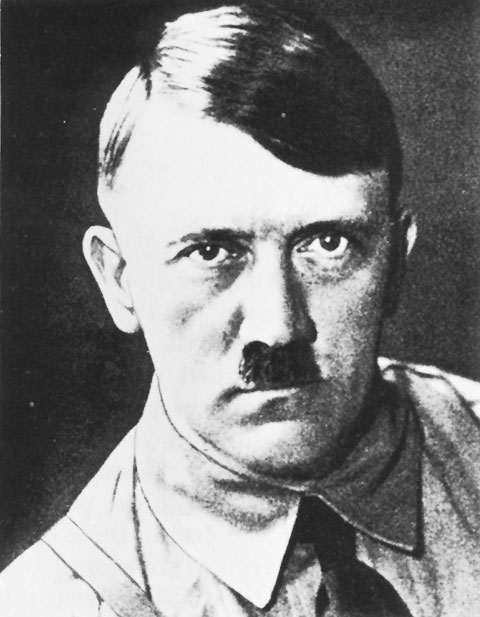
See this guy on the left? You may remember him. He was a fanatic, but a fantastic orator. He was a politician, but a killer. He was a man, but he was responsible for the murder of millions of innocent people. He was Hitler, and he was the face of the new socialism movement in Germany during the 1930s and 40s. 


Now look to the right. The Swastika has grown to become a despised and fear-inducing symbol around the world. It means death. It means control. It means concentration camps. It represents everything that the United States fights against. I represents the failed system that socialism is. There is no better example of socialism than Nazi Germany. So isn't it just a little disturbing when the President of the United States comes out in public and bashes the American system of government? Could he be - dare I say it? - a Marxist himself? 
See for yourself:


"… there is a certain crowd in Washington who, for the last few decades, have said, let’s respond to this economic challenge with the same old tune. “The market will take care of everything,” they tell us. If we just cut more regulations and cut more taxes – especially for the wealthy – our economy will grow stronger. Sure, they say, there will be winners and losers. But if the winners do really well, then jobs and prosperity will eventually trickle down to everybody else. And, they argue, even if prosperity doesn’t trickle down, well, that’s the price of liberty. Now, it’s a simple theory. And we have to admit, it’s one that speaks to our rugged individualism and our healthy skepticism of too much government. That’s in America’s DNA. And that theory fits well on a bumper sticker. But here’s the problem: It doesn’t work. It has never worked. It didn’t work when it was tried in the decade before the Great Depression. It’s not what led to the incredible postwar booms of the ’50s and ’60s. And it didn’t work when we tried it during the last decade. I mean, understand, it’s not as if we haven’t tried this theory." - Obama 


In a way, he's right. When the Pilgrims first hightailed it to the New World to escape religious persecution, they set up a commune right on the shores of the Atlantic Ocean. These settlers shared everything - nobody was better than the other. 
Until one day a revelation hit them. 
They realized that only half of the people were doing the work, while the other half primarily did nothing. 50% of the population was carrying 100% of the labor load. 
There were no incentives to have a better life. After all, everybody lived in the same way. There was no reason to work for advancement. The colony could barely feed themselves. So, Bradford came up with a monumental idea. He decided that everybody should have their own private property and manage it. People had an incentive to grow their own goods. The crops doubled. They had an incentive to trade with the Indians. Trading posts were established. Capitalism was born. 
So yes, America, as it was originally founded in 1620, didn't work. It failed miserably. It was a system of socialism before Karl Marx was even around to dream up the term. It was re-founded in democracy, capitalism and republicanism. So Obama is wrong. Dead wrong. This system works fine. 
It's his system of socialsim that is the miserable, miserable failure. 

Monday, November 21, 2011

Happy Thanksgiving!

Happy Thanksgiving Week! 
"Give thanks to the Lord, for He is good; His love endures forever."
Psalm 107:1

Tuesday, November 15, 2011

Occupy Wall Street


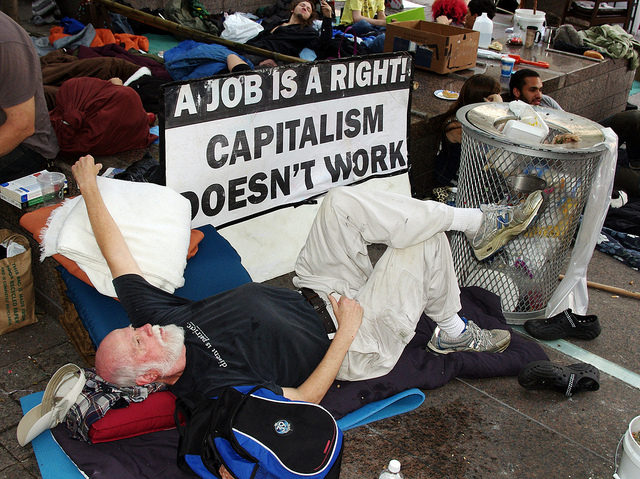
They say a picture is worth a thousand words.  In that case, the millions of pictures that pop up on the Internet regarding the Occupy Wall Street movement spells out something pretty dismal. Just take a look at the picture above. "A Job Is A Right. Capitalism Doesn't Work." I'm sorry, last time I checked, it worked just fine. What doesn't work is when the government sticks its nose into places it doesn't belong - the opposite of capitalism. You know. Socialism, communism and so forth. I'm guessing the Occupiers have failed to check their history books and examine the miserable end products of Stalin's Russia and Hitler's Germany. All sterling examples of welfare states and government doles.

So what if freedom went down the tubes?
So what if millions of people died?
So what if Germany basically self-imploded and became bankrupt and subservient to the west?
It's all about equality. Everybody's entitled to success. Right?

I beg to differ. The Constitution states that we are all entitled to "life, liberty and the pursuit of happiness." The pursuit of happiness. Of success. Nowhere in the document does it say, "you have a right to a job, a right to succeed, and a right to being helped by the government."

There was a time when people took pride in getting a job, providing for their family, and being an independent, entrepreneurial, self-made man or woman. Today the college generation seems to think they are entitled to everything good in life, without earning it.
Wrong. Think again.

Today the Occupiers were ordered to leave Zuccotti Park in New York. Packing up their tents, signs and trash, they will leave the rape, public urination and vandalism behind them for somebody else to clean up. That in itself is a pretty good example of the Occupy Wall Street work ethic.

Sunday, November 6, 2011

Journalism's Decline

There was a time when journalism was respected. I have seriously considered foraying into the field myself, but I often stop and wonder: is it worth it? There are reasons why I question the profession in this day and age.

Take the past week's coverage of the Herman Cain sex allegations, for example. First of all, all of the women accusing Mr. Cain of sexual harassment are anonymous. Second of all, there are no details about what happened. Third, Herman Cain was not a part of the "settlements" thus he cannot say what exactly happened.

And this puddle of anonymous non-facts warrants 90 articles from Politico alone?

Journalism used to entail careful research, fact checking and a strictly adhered to and respected code of ethics. It was the journalist's job to expose criminal activity and uncover seedy business deals. It was the journalist's job to remain totally and completely impartial to political parties and beliefs and report solidified facts to the public. Because when the truth is told, people generally make a logical decision based on real facts.


Mr. Cain's "scandal" is not a fact. It is not a person. It is not a name. It is not a place, time or detailed account. It is a story, and by all accounts, seemingly nothing but fluffy fiction. It is the present state of "journalism" and I seriously doubt if it will be improving anytime soon.

Thursday, October 27, 2011

College Education

The subject of student loans has been popping up in the news lately, and it started me thinking: what is the true value of a college education? The importance of a college education is stressed from preschool to high school graduation.

A moment to reflect. Back in the day, the universities in the United States were not meant to be pillars of scientific exploration or enlightenment. They were meant to train Christian ministers for the field. Until, that is, they were taken over by the liberals of that time. And look at them now. They reverted to humanistic teachings and secular curriculum.

What does that have to do with today? Walk onto a college campus presently and see what whisper of God or patriotism you can find. You might be hard pressed. I'm going through college myself and I have been shocked at the extreme views I have been presented with. It becomes increasingly difficult to read or study any material that doesn't fawn over the theories of Karl Marx, tout the inequality of society in America and subtly blame capitalism for our problems. I can understand now why there are college students protesting on Wall Street. They've learned it in school - in textbooks and from teachers who don't care for the system of American government.

It makes you think twice about investing thousands in a college education.

Friday, December 3, 2010

A Mike Huckabee Christmas Tour


            I met Governor Mike Huckabee. Within the snug confines of a local Borders bookshop, a crowd of people—mostly adults—stood in a line that snaked through bookcases and DVD racks.
            Since it was pouring down rain, the line did not protrude outside. However, there were plenty of people packed within the music aisle, happily discussing whether or not Mike Huckabee would make a better President than Sarah Palin.
            Having driven there early, I was there for two hours before the Governor actually arrived. Standing in one spot for hours can get tiresome, so some people sat on floors, waiting for the small podium to be occupied by the former Presidential hopeful.
            In retrospect, events like these are the best kind.  After weeks—or even months—of wallowing around in a liberal dominated media world, hearing progressives pining for the conservative demise and the death of the Tea Party, it’s nice to converge with like minded people.
            People who are tax-paying, hard working, normal American citizens with no political motivation other than seeing things done right in their country; a place where so many men and women have died to make it free. It’s a great reminder of how many of us there are.
            So, after a long wait, and some enjoyable conversations with a seven foot tall man in a cowboy hat and some independent voters, we got our books signed by the Governor. He was very amiable, and I couldn’t help but think how I would much prefer someone like him as President than anyone else.
            In summary, it was a nice evening that lifted the spirits a bit. It’s always nice to know that there are other people out there who are just as concerned about the welfare of this country as we are. I might also add that it was nice to see Mike Huckabee’s tour bus, which had a large, “MERRY CHRISTMAS” painted on the back. It’s refreshing to see someone actually call the holiday what it is: Christmas.
            I was reminded that unification is of the utmost importance in a republic. John Hancock commented after the signing of the Declaration of Independence that they must all hang together. To this Benjamin Franklin replied, “Yes, we must, indeed, all hang together, or most assuredly we will all hang separately.”
            Truer words were never spoken. 

Tuesday, November 9, 2010

A Look at the Constitution


            The Constitution was penned during the Constitutional Convention of 1787, in Philadelphia. Historically speaking, the Constitution was a document that outlined the procedural and legal rules of governing the United States of America as a free republic.
            Up until that point, the United States had been a facet of England, subject to their King and likewise, their monarchial rule.
America, young as it was, possessed some of the greatest minds the world has ever known. General George Washington, as their President, presided over the Constitutional Convention. Benjamin Franklin was present, as well as Thomas Jefferson. James Madison, Patrick Henry, John Jay, Alexander Hamilton, Roger Sherman and many others were also in attendance, as well as over forty others.
            They were well aware that to solidify the blossoming independent republic-democracy of the United States, a unique system of government needed to be implemented and properly administered. In short, they wanted a government that the people could control, and visa versa.
            To accomplish this task, many of the Founding Fathers turned to the writings and examples of ages past. In the centuries before, many European countries had dreamed of having a government in which they openly participated, held in check, and prevented greedy rulers from taking over and exploiting the people. A government where free speech, the right to worship freely and the right to work for wages was their ultimate goal.
            To accomplish these goals, Europe began first with a Greek system of governing known as Democracy, from the Greek words Demos (the people) and Kratos (authority or government). This system allowed the population of Greece to actively participate in their governmental policies.
            As the centuries progressed, the Roman Empire constructed an even better democratic form of government in which even more citizens were able to participate. This was known as a republic.
            In 1216, the English nobility was living under the regime of monarchies in which one man or woman wielded complete power over the entire land. Fearing for their very lives under a cowardly and sometimes oppressive King John, a group of nobles forced him into signing a monumental democratic document known as the Magna Carta. This agreement guaranteed Englishmen certain rights that could not be infringed, regardless of what any one king might say.
            But, as history would have it, Europe fell under the shadow of Roman Catholicism and Papal rule. The theocracy of the Dark Ages, coupled by rampant disease and war seemed to shun all efforts or dreams of democracy for the time being.
            In the fifteen hundreds, a Catholic monk named Martin Luther King began a spiritual revival of Christianity by asserting that men were saved by grace rather than works. His findings amazed and delighted the European continent and a “Great Awakening” ensued.
            The Catholic Church, their power threatened by the sudden spread of Christianity, extended their iron hand around new converts and had them either executed or imprisoned. In turn, converts began to flee to the New World, or North America, to escape religious persecution and worship God as they saw fit. In this way America was settled primarily by Protestants, who provided a strongly Scriptural foundation for the later Founding Fathers of the United States.         
           
            As the Founders gathered in 1787 to create their new government, they mulled over the past failures of democracy and determined not to make the same mistakes. Unlike the ultimately unsuccessful “free governments” of Europe, the Founders realized that man was inherently sinful and would eventually destroy himself and each other in the end. In this way, they set up their government by recognizing this sobering fact, rather than ignoring it and hoping that man would merely abstain from sin.
            The Constitution is more than a piece of paper with rules written on it. It is the embodiment of, and culmination of, the thousands of years that ensued before it was created.
            The Constitution outlines the rights of the people, the states of the Union, and the government itself. Without declaring anarchy, it designates certain powers to certain branches of government in order to prevent tyranny from consolidating itself in the form of a strong central government. The separation between the Federal Government and the States’ Governments keeps one party from gaining too much power or corrupting the other. The ultimate authority in the republic, however, is the citizens. It is their job and duty to participate in their government and to make sure that their sacred rights are not infringed in any way.
           
            When the Constitution was being written, there was much debate over what rights they should grant the people, the government, and the states. Furthermore, the Founders made it very clear that they had every intention of creating a government that practiced the belief of limited government. In this way government does not have ultimate power, in that its power comes from the people whom it governs through law.
            The rights that were ultimately decided on are included in the Constitution, but further specified in the Bill of Rights, which came about only because of the insistence of certain members of the Convention to include basic rights in the Constitution.
            This list of rights includes ten amendments including the right of religion, freedom of speech, freedom of the press, freedom to peaceably assemble and the freedom to petition the government for a redress of grievances.   
            Amendments are added to the Constitution in order to clarify something that might otherwise be unclear to the people concerning certain rights or laws. In order to add an amendment, it must be proposed and likewise ratified by the states, meaning that their legislatures must give a unanimous three-fourths approval or a three-fourths approval from a special state ratification convention.
            In all, there are twenty-seven amendments. Some of them, like Amendment V, guarantee an accused criminal a fair and speedy trial. Others, like Amendment XVIII, prohibited the sale of alcohol in any form in the United States.
            In the case of the latter amendment, the backlash and refusal of the American public to cooperate with the law, Amendment XXI repealed Amendment XVIII! Amendments were also made to guarantee the rights of African Americans to vote, and the right of women to vote. In 1971, eighteen year-olds were given the right to vote as well.
           
            The Constitution was written by men who were heavily influenced by a predominately Christian society. Their morals and values transferred into the writings of the document. They recognized that man was inherently sinful, and they sought to safeguard our society against those who would exploit us by creating checks and balances, rights of citizens and the Republican court system.
            The Constitution is a unique and Divinely-inspired document that has lasted longer than any other Constitution in the history of the world. It has been emulated over and over again, but no other country has thrived under it as well as the United States. It preserves the basic rights of all people, regardless of race or religion, and, in recognizing that man is prone to sin, takes necessary actions to prevent corruption and vice.
            It is logical to assume that without the guidance of such faith driven men, and the blessing of God Himself, the United States quite possibly would have ended up like the seemingly “free country” of France after their Revolution—a three year ordeal that ended with thousands dead and none free.
            Truly, the Constitution must be understood in its entirety for what it is: a safeguard of liberty, a guidebook for a free republic and an inspired gift from God to the blessed citizens of the United States of America. 
        
Separation of Church & State: What the Founders Meant      
Sources:
Keese, Tim American Government BJU Press