Tuesday, November 9, 2010

A Look at the Constitution


            The Constitution was penned during the Constitutional Convention of 1787, in Philadelphia. Historically speaking, the Constitution was a document that outlined the procedural and legal rules of governing the United States of America as a free republic.
            Up until that point, the United States had been a facet of England, subject to their King and likewise, their monarchial rule.
America, young as it was, possessed some of the greatest minds the world has ever known. General George Washington, as their President, presided over the Constitutional Convention. Benjamin Franklin was present, as well as Thomas Jefferson. James Madison, Patrick Henry, John Jay, Alexander Hamilton, Roger Sherman and many others were also in attendance, as well as over forty others.
            They were well aware that to solidify the blossoming independent republic-democracy of the United States, a unique system of government needed to be implemented and properly administered. In short, they wanted a government that the people could control, and visa versa.
            To accomplish this task, many of the Founding Fathers turned to the writings and examples of ages past. In the centuries before, many European countries had dreamed of having a government in which they openly participated, held in check, and prevented greedy rulers from taking over and exploiting the people. A government where free speech, the right to worship freely and the right to work for wages was their ultimate goal.
            To accomplish these goals, Europe began first with a Greek system of governing known as Democracy, from the Greek words Demos (the people) and Kratos (authority or government). This system allowed the population of Greece to actively participate in their governmental policies.
            As the centuries progressed, the Roman Empire constructed an even better democratic form of government in which even more citizens were able to participate. This was known as a republic.
            In 1216, the English nobility was living under the regime of monarchies in which one man or woman wielded complete power over the entire land. Fearing for their very lives under a cowardly and sometimes oppressive King John, a group of nobles forced him into signing a monumental democratic document known as the Magna Carta. This agreement guaranteed Englishmen certain rights that could not be infringed, regardless of what any one king might say.
            But, as history would have it, Europe fell under the shadow of Roman Catholicism and Papal rule. The theocracy of the Dark Ages, coupled by rampant disease and war seemed to shun all efforts or dreams of democracy for the time being.
            In the fifteen hundreds, a Catholic monk named Martin Luther King began a spiritual revival of Christianity by asserting that men were saved by grace rather than works. His findings amazed and delighted the European continent and a “Great Awakening” ensued.
            The Catholic Church, their power threatened by the sudden spread of Christianity, extended their iron hand around new converts and had them either executed or imprisoned. In turn, converts began to flee to the New World, or North America, to escape religious persecution and worship God as they saw fit. In this way America was settled primarily by Protestants, who provided a strongly Scriptural foundation for the later Founding Fathers of the United States.         
           
            As the Founders gathered in 1787 to create their new government, they mulled over the past failures of democracy and determined not to make the same mistakes. Unlike the ultimately unsuccessful “free governments” of Europe, the Founders realized that man was inherently sinful and would eventually destroy himself and each other in the end. In this way, they set up their government by recognizing this sobering fact, rather than ignoring it and hoping that man would merely abstain from sin.
            The Constitution is more than a piece of paper with rules written on it. It is the embodiment of, and culmination of, the thousands of years that ensued before it was created.
            The Constitution outlines the rights of the people, the states of the Union, and the government itself. Without declaring anarchy, it designates certain powers to certain branches of government in order to prevent tyranny from consolidating itself in the form of a strong central government. The separation between the Federal Government and the States’ Governments keeps one party from gaining too much power or corrupting the other. The ultimate authority in the republic, however, is the citizens. It is their job and duty to participate in their government and to make sure that their sacred rights are not infringed in any way.
           
            When the Constitution was being written, there was much debate over what rights they should grant the people, the government, and the states. Furthermore, the Founders made it very clear that they had every intention of creating a government that practiced the belief of limited government. In this way government does not have ultimate power, in that its power comes from the people whom it governs through law.
            The rights that were ultimately decided on are included in the Constitution, but further specified in the Bill of Rights, which came about only because of the insistence of certain members of the Convention to include basic rights in the Constitution.
            This list of rights includes ten amendments including the right of religion, freedom of speech, freedom of the press, freedom to peaceably assemble and the freedom to petition the government for a redress of grievances.   
            Amendments are added to the Constitution in order to clarify something that might otherwise be unclear to the people concerning certain rights or laws. In order to add an amendment, it must be proposed and likewise ratified by the states, meaning that their legislatures must give a unanimous three-fourths approval or a three-fourths approval from a special state ratification convention.
            In all, there are twenty-seven amendments. Some of them, like Amendment V, guarantee an accused criminal a fair and speedy trial. Others, like Amendment XVIII, prohibited the sale of alcohol in any form in the United States.
            In the case of the latter amendment, the backlash and refusal of the American public to cooperate with the law, Amendment XXI repealed Amendment XVIII! Amendments were also made to guarantee the rights of African Americans to vote, and the right of women to vote. In 1971, eighteen year-olds were given the right to vote as well.
           
            The Constitution was written by men who were heavily influenced by a predominately Christian society. Their morals and values transferred into the writings of the document. They recognized that man was inherently sinful, and they sought to safeguard our society against those who would exploit us by creating checks and balances, rights of citizens and the Republican court system.
            The Constitution is a unique and Divinely-inspired document that has lasted longer than any other Constitution in the history of the world. It has been emulated over and over again, but no other country has thrived under it as well as the United States. It preserves the basic rights of all people, regardless of race or religion, and, in recognizing that man is prone to sin, takes necessary actions to prevent corruption and vice.
            It is logical to assume that without the guidance of such faith driven men, and the blessing of God Himself, the United States quite possibly would have ended up like the seemingly “free country” of France after their Revolution—a three year ordeal that ended with thousands dead and none free.
            Truly, the Constitution must be understood in its entirety for what it is: a safeguard of liberty, a guidebook for a free republic and an inspired gift from God to the blessed citizens of the United States of America. 
        
Separation of Church & State: What the Founders Meant      
Sources:
Keese, Tim American Government BJU Press

Wednesday, September 29, 2010

Tea Party


There was no other revolution in the world like America's.  The Russian Revolution and the French Revolution all structurally changed their countries. Thousands upon thousands died. There was mass murder, and even when the Revolution was finished, true freedom was never really attained.
    The United States, however, had a different kind of Revolution.
Society didn't conform to the shape of the war. People weren't blood-thirsty rebels that wanted to kill the British. They just wanted their rights back. The rights which King George and the Parliament had taken away. When their requests for independence  were ignored, they still asked peacably for their rights to be restored. With the occurance of the Boston Massacre, tempers flared, and everything began to set into place. The dumping of the tea into the harbor, or The Boston Tea Party, showed that they didn't want to be taxed or controlled by a government that didn't even represent them. So, the patriots took up arms and had to forcibly press a very powerful army into giving them their freedom.
     With the publication of Thomas Paine's Common Sense, and the signing of the Declaration of Independence, people stood together for the same cause: Freedom.
     Wow. How radical.
    When we achieved our independence, our society wasn't altered in some extreme way. People went on as they had before, but this time they were free.
     It makes me sad to think that so many of our precious liberties that so many men and women have died and continue to die for are slipping away. All the more reason for us to stand up and fight back against a goverment that is overstepping its authority and trying to deny us our freedom.
  Only this time it's not Britain. It's our own government that was established by our Founding Fathers.

- The Liberty Belle


Monday, September 27, 2010

What Could Have Been

     It's interesting to think that the United States possibly could have ended up as a Catholic monarchy. 
Long before the Pilgrims set sail on the Mayflower, Martin Luther King was debating the issue of free salvation at Worms with a Catholic establishment. At a time when the church ruled all, a sort of theocracy and dictatorship was in place. When Martin Luther began preaching that salvation was a gift, and that you only needed to accept it to gain eternal life, his message didn't sit well with a government that ruled through the regulations of Catholicism. The converts to Christianity were persecuted because they presented a threat to their power.
     Because of this persecution, the new Protestants fled elsewhere, eventually seeking refuge in the New World so that they could worship God as they pleased. In this way America was settled predominantly by Protestants. A simple, Christian nation. They'd come here to worship God freely, and they did. But what would have happened had Martin Luther not begun the European Reformation? It's quite possible that America would have been settled by Spain, France, England, (which the Protestants, were for the most part), but not for religious freedom. Monetary gain would have been a huge motivation for settlement, as would extra land for the mother countries.
     In that respect, it's even more fascinating to study the pattern of "coincidences" that led to the unique establishment of the United States as a free and Christian nation.

- The Liberty Belle

Wednesday, September 22, 2010

Government Nannies

     In writing about the importance of education lately, I felt it appropriate to recommend a book that taught me a lot about our public school systems that I didn't previously know: Government Nannies. This book was written by Cathy Duffy long before the Obama Administration or even the Bush Administration. It goes over government's role in education--and its power over it--and the goals that were set in Clinton's "Goals 2000."
     I read this book years ago, and it's an excellent source that explains a pretty socialistic agenda merely by relaying pure facts. Read the book, and you'll forever think differently about Federal involvement in education. 
Government Nannies Government Nannies   


- The Liberty Belle

Monday, September 20, 2010

An Educated Country

     The Founding Fathers talked about education a lot.  John Adams said that, "liberty cannot be preserved without a general knowledge among the people." Edward Everett said, "education is a better safeguard of liberty than a standing army."
    In short, there are two different types of education. The first teaches you to read, write, add up math problems and figure out scientific notations. The second is the education of civil thinking. Civil thinking is the ability not only to read and write, but to apply those skills to understanding and participating intelligently in the affairs of the country. An understanding of the United States' heritage would be, above all, extremely important. The ability to examine and understand issues like policies and war would be a must.
    The Founding Fathers realized that if a democracy was going to exist and flourish, the people who had authority over the government must be educated, intelligent citizens who were aware of their past, present, and possible future positions. Thomas Jefferson pointed out that, "if a nation expects to be ignorant and free, in a state of civilization, it expects what never was and never will be."
     So what happens when education, a fundamental tool in sustaining a republican-democracy, becomes corrupted? Would it not have the opposite effect of building a nation up? Wouldn't it, instead, tear it down? When people don't know their history, they cannot adequately make decisions about their future without making the same mistake twice--or a worse one. Education is only helpful when it encourages discernment, moral responsibility, and the love of one's country through thick and thin.
    Whether or not we're presently in that position is for you to decide.

- The Liberty Belle

Government Nannies 

Friday, September 17, 2010

A Few Random Thoughts

     This is a post about nothing in particular; just a few observations, perhaps. First of all, the whole story about Michelle Obama reportedly saying that life in the White House is "hell" and that she "can't stand it" is not something I'm awfully glad to hear my First Lady saying. I'm sure that helping to run a country is difficult. I am not, in any way, saying that it's easy. But what about all those vacations? Tell me that my tax dollars provided you with a nice, sunny vacation that put a spring in your step, a twinkle in your eye. After all, I'm counting on you and your husband to help me in return.....Right?
     Second of all, Obama trying to spend more money to save an already pretty lousy economy isn't my idea of an economic miracle drug. Maybe your mother once told you to save your money and spend it wisely. I'm sure she didn't say, "If you're deep in debt, son, make sure that you spend more money, so you can somehow become successful again." No, this mentality makes no sense. It would seem that ruining the economy is almost deliberate, but I'll leave that for you to decide.
     Third, I notice more and more these days how similar Nazi Germany is to our current society. Propaganda, (left-leaning media) control of the youth (Federally-run education system), and creating racial tension to divide people (think of all the cries of racism there's been in the last year or so). Not that this is Hitler's HofbrÀuhaus, of course, but consider: Nazi Germany was overthrown because of "social justice." That worked out great, didn't it? Especially for the Jews. Just grand. Socialism is supposedly the new way to go for the United States. How many people think Socialism is great? A lot more than I'd like to see. I'd think Hitler's less-than-twenty-year "thousand year empire" would give some sort of negative evidence for the socialists.
     There's not a lot I can say anymore. Our leaders are our leaders for a reason. Even if we don't particularly like or agree with them, at least we can know that God uses every single person in the world for His purposes, whether they know it or like it.

- The Liberty Belle

Socialism Sucks Bumper Sticker


Wednesday, September 15, 2010

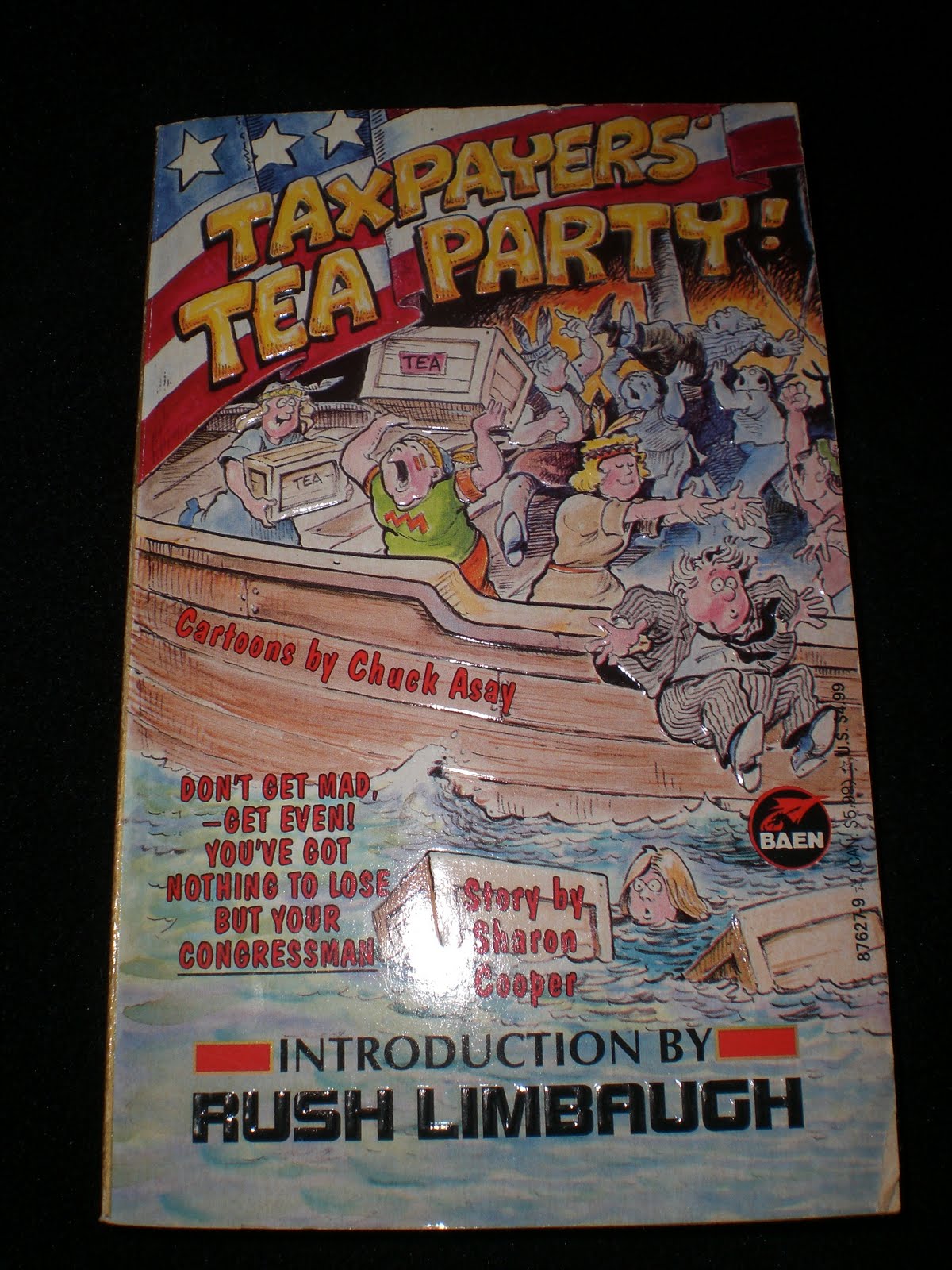
Tea Parties: In 1994

     This is a book that I bought for 25 cents at a used charity store. It's called the "Taxpayer's Tea Party." What with all the Tea Parties going around, I thought I'd mention that this book is from 1994. I think it goes to show that in every decade, there is some sort of a crisis to solve, some sort of convoluted problem created by government that the people have to remedy.
     The question is whether or not, every decade, will We the People do our job?

- The Liberty Belle